
What you need to know
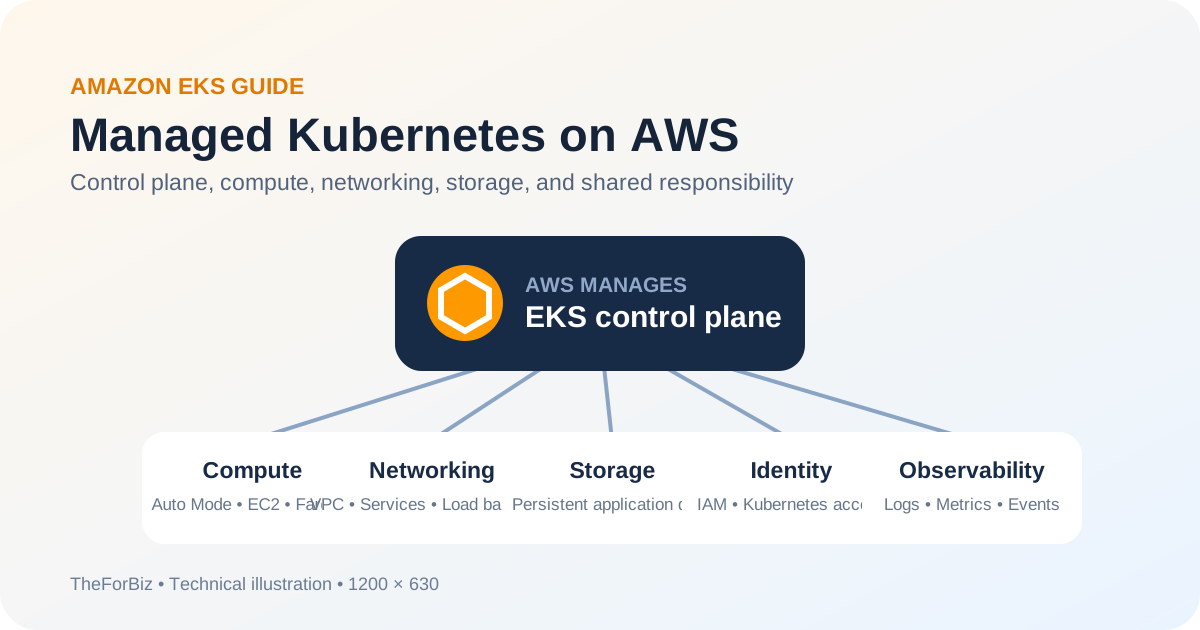
- Amazon EKS is AWS's managed Kubernetes service. AWS operates the Kubernetes control plane and keeps it highly available across multiple Availability Zones.
- Teams can run workloads with EKS Auto Mode, EC2-based nodes, AWS Fargate, or supported hybrid infrastructure.
- EKS reduces control-plane work, but customers still own workload design, identity, data protection, observability, and other responsibilities that vary by compute model.
- EKS is a strong fit when Kubernetes compatibility and ecosystem flexibility matter enough to justify Kubernetes's operational complexity.
What is Amazon EKS?
Amazon Elastic Kubernetes Service, usually called Amazon EKS, is a managed AWS service for running Kubernetes. It removes the need to install, operate, and maintain the Kubernetes control plane yourself. AWS provisions and scales the API servers and backend persistence layer, detects unhealthy control-plane nodes, replaces them, and applies control-plane patches.
EKS runs upstream Kubernetes and is Kubernetes conformant. Standard Kubernetes APIs, manifests, and much of the wider Kubernetes ecosystem therefore remain available. The practical benefit is portability at the application layer combined with managed AWS infrastructure and integrations.
Continue reading: Read the concise EKS definition · AWS: What is Amazon EKS? ↗
How Amazon EKS works
Kubernetes separates a cluster into a control plane and a data plane. The control plane exposes the Kubernetes API, stores cluster state, and decides where workloads should run. The data plane supplies the compute that runs Pods and containers.
In an EKS cluster, AWS operates the managed control plane in an AWS-managed virtual network. AWS designs that control plane to avoid a single point of failure and distributes its components across Availability Zones in an AWS Region. Your cluster's nodes and other resources run in a customer-managed VPC or, for supported hybrid options, on connected infrastructure.
Nodes communicate with the managed Kubernetes API endpoint. You continue to use familiar Kubernetes tools such as kubectl and declarative manifests, while AWS APIs and services are used for cluster creation, identity integration, networking, load balancing, storage, logging, and infrastructure management.
- AWS-managed control plane: API servers, cluster state, availability, scaling, replacement, and patching.
- Customer workload layer: applications, namespaces, policies, secrets, container images, and service configuration.
- AWS integrations: services such as IAM, VPC, Elastic Load Balancing, CloudTrail, and supported storage and observability tools.
Continue reading: Cloud Computing glossary · AWS: EKS control plane ↗
EKS compute options
EKS provides more than one way to supply compute. The right choice depends on how much infrastructure control the team needs and how much operational work it wants AWS to absorb.
EKS Auto Mode expands the AWS-managed boundary beyond the control plane. It can automate compute provisioning, scaling, pod and service networking, load balancing, cluster DNS, block storage, and other cluster infrastructure. AWS describes Auto Mode as suitable for teams that want a more integrated Kubernetes operating model.
EC2-based options provide greater control over instance types, operating systems, scheduling, and node configuration. EKS managed node groups automate parts of node provisioning and lifecycle management, while self-managed nodes leave more work with the customer. AWS Fargate runs Pods without customers managing EC2 worker nodes, but it has a different capability and operating model from Auto Mode.
- EKS Auto Mode for a broader AWS-managed Kubernetes infrastructure layer.
- Managed node groups for EC2 capacity with an AWS-assisted node lifecycle.
- Self-managed EC2 nodes when specialized control is required.
- AWS Fargate for eligible serverless Pod execution.
- Hybrid Nodes for supported on-premises or edge machines connected to an AWS-hosted EKS control plane.
Continue reading: AWS: Amazon EKS FAQs ↗
Amazon EKS architecture in plain English
A typical EKS environment includes an AWS-managed control plane and a customer-visible network where application resources run. The control plane is not placed directly inside the customer's VPC. EKS creates managed network interfaces in selected subnets so the control plane and nodes can communicate.
Applications are packaged as containers and scheduled into Pods. Kubernetes Services provide stable discovery and routing inside the cluster. AWS load balancers can expose selected applications, while storage integrations can attach persistent volumes. Identity and permissions span both AWS IAM and Kubernetes authorization, so teams need to design both layers deliberately.
High availability is not automatic for the application just because the control plane is highly available. Workloads need suitable replica counts, topology rules, disruption budgets, health checks, scaling, and distribution across failure domains.
Continue reading: Availability Zone definition · AWS: VPC and subnet considerations ↗
What AWS manages and what you still manage
EKS follows the AWS shared responsibility model. AWS is responsible for the managed Kubernetes control plane, including the infrastructure required to deliver it securely and reliably. Customer responsibility covers the workloads and many cluster-level choices. The exact boundary changes with Auto Mode, managed nodes, Fargate, or self-managed infrastructure.
Customers normally remain responsible for application code, container images, Kubernetes resource configuration, access design, secrets, data protection, network policies, logging requirements, vulnerability management for customer-controlled components, and safe upgrade planning. Managed services reduce undifferentiated infrastructure work; they do not remove the need for platform governance.
- Use least-privilege access across both IAM and Kubernetes roles.
- Keep supported Kubernetes versions, node images, and customer-managed add-ons current.
- Separate production workloads and sensitive data according to risk.
- Monitor control-plane activity, application behavior, capacity, and cost.
- Test recovery, scaling, and upgrade procedures before they are urgent.
Continue reading: AWS: EKS security best practices ↗
Benefits and tradeoffs of EKS
The main benefit of EKS is that it combines conformant Kubernetes with an AWS-managed control plane. Teams can use established Kubernetes deployment patterns and tools while avoiding the work of building and maintaining the control plane. AWS integrations can also reduce the effort required to connect identity, networking, load balancing, storage, and logging.
The tradeoff is that Kubernetes remains a complex distributed system. Teams still need platform skills, clear ownership, security controls, observability, upgrade discipline, and cost management. For a small application with simple deployment needs, a less complex AWS container service may require less operational knowledge. EKS earns its place when Kubernetes capabilities, portability, scale, or ecosystem compatibility provide clear value.
Common Amazon EKS use cases
Organizations use EKS to operate microservices, web APIs, internal platforms, event-driven services, batch workloads, machine learning systems, and software that needs consistent Kubernetes deployment patterns. It can support multi-team platforms where central engineers provide shared guardrails while product teams deploy their own services.
Hybrid Nodes and EKS Anywhere address different hybrid needs. Hybrid Nodes connect customer-managed machines to a control plane hosted by Amazon EKS in AWS. EKS Anywhere is customer-managed Kubernetes software intended for on-premises and edge environments, including disconnected or air-gapped settings. They should not be treated as the same product.
Continue reading: Kubernetes Platform term · AWS: Amazon EKS FAQs ↗
When should you choose Amazon EKS?
Choose EKS when Kubernetes is an intentional platform decision rather than a default container choice. Strong reasons include an existing Kubernetes operating model, workloads that depend on Kubernetes APIs or ecosystem tools, a need for consistent deployment patterns across environments, or a platform team that can support shared cluster standards.
Before adoption, define ownership for the cluster, applications, security, networking, data, upgrades, incident response, and spending. Run a limited production-representative pilot, not only a hello-world deployment. Measure deployment reliability, recovery, engineering effort, resource efficiency, and the team's ability to operate the platform safely.
- Confirm that Kubernetes features solve a real workload or organizational need.
- Select the compute model by required control, workload constraints, and operating capacity.
- Design identity, networking, observability, backup, and upgrade paths before migration.
- Model the control-plane and workload infrastructure costs together.
- Document a simpler alternative and explain why EKS is the better fit.
Continue reading: AWS: EKS Best Practices Guide ↗
Frequently asked questions
What does Amazon EKS stand for?
Amazon EKS stands for Amazon Elastic Kubernetes Service, AWS's managed service for running Kubernetes.
Does EKS manage worker nodes?
AWS always manages the EKS control plane. Worker-node responsibility depends on the compute option. Auto Mode manages more of the infrastructure, managed node groups automate parts of the EC2 node lifecycle, and self-managed nodes leave more responsibility with the customer.
Is Amazon EKS serverless?
EKS itself is a managed Kubernetes service. Eligible Pods can run on AWS Fargate without customer-managed EC2 nodes, while EKS Auto Mode provides a different AWS-managed infrastructure model based on EC2 capacity.
Is EKS only for workloads in AWS?
No. Standard EKS runs an AWS-hosted control plane and can use Hybrid Nodes on connected on-premises or edge infrastructure. EKS Anywhere is a separate customer-managed option for Kubernetes clusters that run outside AWS, including disconnected environments.
What is the difference between Kubernetes and EKS?
Kubernetes is the open-source orchestration system. EKS is an AWS managed service that runs conformant Kubernetes and operates the cluster control plane, with optional AWS-managed compute and infrastructure capabilities.