
In simple words
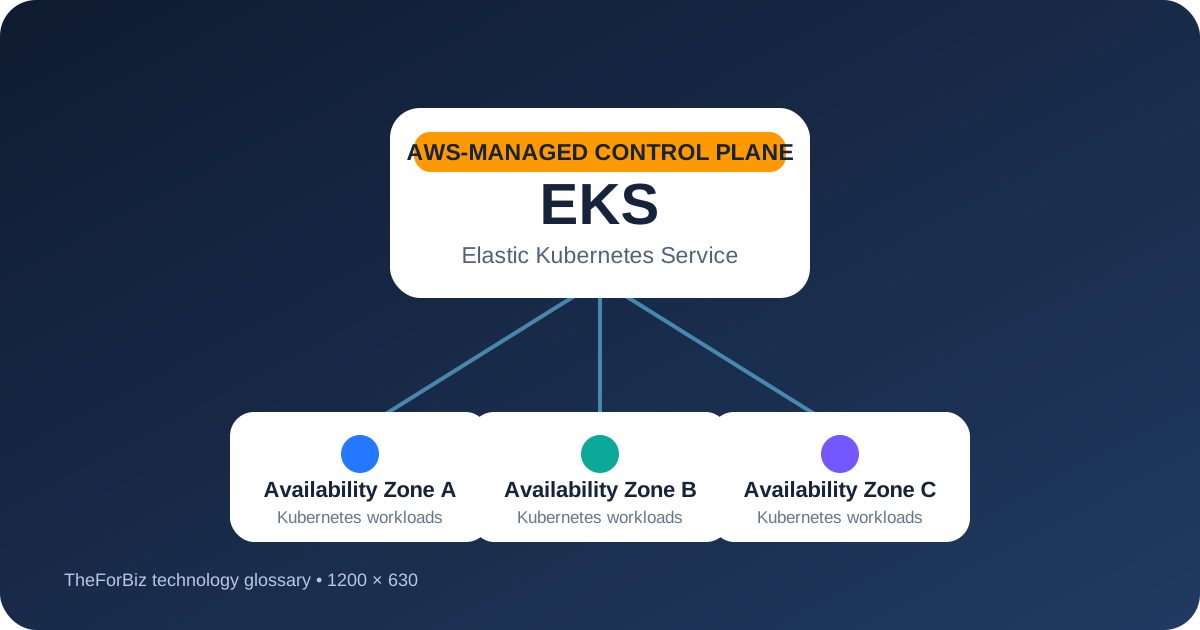
EKS means Amazon Elastic Kubernetes Service. AWS runs and maintains the Kubernetes control plane. You choose how the application workloads run and remain responsible for the parts of the cluster and applications that fall on the customer side of the shared responsibility model.
How it works
What does EKS manage?
A Kubernetes cluster has a control plane that schedules and monitors workloads and a data plane where containers run. Amazon EKS provisions, scales, patches, and monitors the control plane across multiple AWS Availability Zones. AWS also replaces unhealthy control-plane nodes.
Workloads can run through EKS Auto Mode, EC2-based node groups, AWS Fargate, or supported hybrid infrastructure. The responsibility boundary changes with the compute option. Teams still need to manage application code, container images, access, data, observability, network policies, and other customer-controlled configuration.
Key distinction
EKS vs Kubernetes
Kubernetes is the open-source container orchestration system. Amazon EKS is an AWS service that runs conformant Kubernetes and manages its control plane. EKS supports standard Kubernetes APIs and common ecosystem tools, but it adds an AWS-managed operating layer and integrations.
Common uses
When is EKS used?
- Running containerized web applications, APIs, microservices, and batch workloads.
- Building a shared Kubernetes platform for multiple product teams.
- Using standard Kubernetes deployment patterns with AWS identity, networking, load balancing, storage, and logging services.
- Connecting supported on-premises or edge machines through EKS Hybrid Nodes.
EKS FAQs
What is EKS in AWS?
EKS is Amazon Elastic Kubernetes Service. It is AWS's managed Kubernetes service for deploying and operating Kubernetes clusters.
What does EKS manage?
Amazon EKS provisions, scales, patches, and monitors the Kubernetes control plane. Your responsibilities depend on whether you use Auto Mode, managed node groups, Fargate, or other compute options.
Is EKS the same as Kubernetes?
No. Kubernetes is the open-source container orchestration system. EKS is an AWS service that runs conformant Kubernetes and manages key cluster infrastructure for you.