
What you need to know
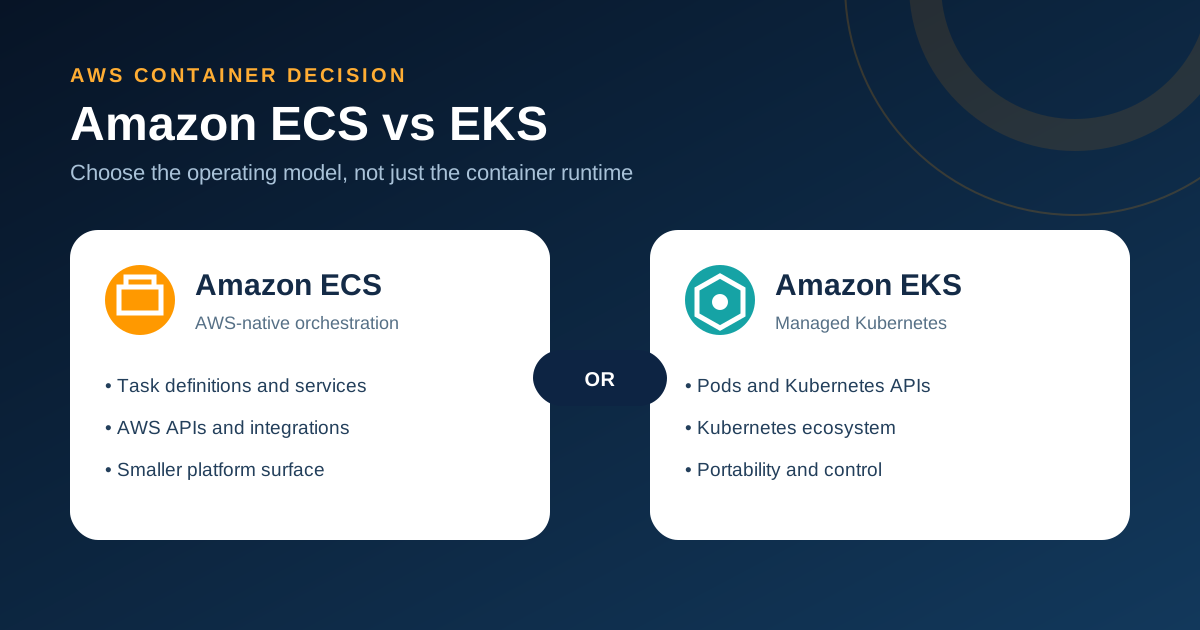
- Amazon ECS is AWS-native container orchestration; Amazon EKS runs conformant Kubernetes with Kubernetes APIs.
- ECS usually gives an AWS-focused team a shorter operational path, while EKS is the stronger fit when Kubernetes compatibility is a firm requirement.
- Both services can use Amazon EC2 and AWS Fargate, so the orchestrator and operating model matter more than a simple serverless-versus-server comparison.
- Choose from workload requirements, team skills, portability needs, governance, and total operating effort rather than feature count alone.
What is the difference between Amazon ECS and EKS?
Amazon Elastic Container Service and Amazon Elastic Kubernetes Service both orchestrate containers on AWS, but they expose different platforms. ECS is an AWS-native service built around concepts such as task definitions, tasks, services, and clusters. EKS provides an AWS-managed Kubernetes control plane and uses Kubernetes concepts such as Pods, Deployments, Services, namespaces, and the Kubernetes API.
The central decision is therefore not whether either service can run containers at scale. Both can. The decision is whether the organization wants the simpler AWS-native ECS operating model or specifically needs the Kubernetes API, ecosystem, deployment model, and related skills that EKS preserves.
Continue reading: Read the concise EKS definition · Read the full Amazon EKS guide · AWS: ECS and EKS product comparison ↗
Amazon ECS vs EKS side by side
Use the comparison below as a screening tool. A final choice should still be tested against workload constraints, security requirements, existing tooling, and the skills of the team that will operate the platform after launch.
| Decision area | Amazon ECS | Amazon EKS |
|---|---|---|
| Orchestrator | AWS-native container orchestration | Conformant Kubernetes managed by AWS |
| Primary APIs | AWS ECS APIs and task definitions | Kubernetes APIs and manifests, plus AWS APIs |
| Core workload unit | Task | Pod |
| Compute choices | Fargate, EC2, ECS Managed Instances, and ECS Anywhere | EKS Auto Mode, Fargate, managed or self-managed EC2 nodes, and hybrid options |
| Learning curve | Usually lower for teams already centered on AWS | Higher because Kubernetes concepts and operations remain relevant |
| Portability | Application containers can move, but orchestration definitions are ECS-specific | Kubernetes APIs improve tooling and deployment-pattern portability, although cloud integrations still need adaptation |
| Best fit | AWS-first teams that want managed orchestration with fewer platform layers | Teams with a clear Kubernetes requirement, ecosystem dependency, or established Kubernetes platform practice |
Operations and team skills
ECS removes the Kubernetes layer. Teams work with AWS-native deployment objects and integrations, which can reduce the number of platform concepts they must design, secure, upgrade, and troubleshoot. This is often valuable for small platform teams or applications that do not depend on Kubernetes-specific behavior.
EKS removes the work of building and operating the Kubernetes control plane, but Kubernetes does not disappear. Teams still need sound practices for workloads, access, networking, policies, observability, upgrades, capacity, and failure recovery. EKS Auto Mode can take over more infrastructure work, but application and cluster governance remain customer responsibilities.
- Prefer ECS when the team wants AWS-native primitives and no requirement justifies Kubernetes complexity.
- Prefer EKS when the team already operates Kubernetes well or needs Kubernetes APIs, controllers, policies, or ecosystem tools.
- Do not treat familiarity with Docker alone as Kubernetes readiness; cluster operations require additional skills and ownership.
Continue reading: AWS: Choosing an AWS container service ↗
Compute, scaling, and deployment choices
The orchestrator does not force a single compute model. ECS can place tasks on AWS Fargate, customer-managed EC2 capacity, ECS Managed Instances, or registered external infrastructure. EKS can run workloads through Auto Mode, Fargate, managed node groups, self-managed nodes, or supported hybrid infrastructure.
Fargate is available to both services, but the surrounding configuration differs. In ECS, a task definition and service describe the application. In EKS, Pods and Kubernetes controllers describe it. EKS Auto Mode is not the same as Fargate: it uses managed EC2 capacity and automates infrastructure capabilities including node provisioning, networking, load balancing, and block storage.
Continue reading: How EKS Auto Mode changes operations · AWS: What is Amazon ECS? ↗
Portability and ecosystem tradeoffs
EKS offers the Kubernetes API and access to the Kubernetes ecosystem. That can support common deployment patterns across environments and reduce the amount of application-layer change when moving Kubernetes workloads. It does not make every workload automatically portable. Identity, storage, networking, load balancers, observability, and managed-service integrations may still be specific to AWS.
ECS definitions are AWS-specific, but the containers themselves remain standard images. If an organization expects to stay primarily on AWS and does not need Kubernetes compatibility, the value of theoretical orchestration portability may be smaller than the ongoing cost of Kubernetes expertise.
How costs differ
Compare total platform cost, not only the price of compute. Include control-plane or service charges, EC2 or Fargate capacity, storage, load balancers, data transfer, logs, support, third-party tooling, and the engineering time required to operate the platform.
AWS states that ECS pricing depends on the capacity option, while EKS has per-cluster pricing and additional charges for some capabilities, including Auto Mode-managed instances. Prices and support policies can change, so use the current AWS pricing pages and the AWS Pricing Calculator for a workload-specific estimate instead of relying on a fixed number in an architectural decision.
Continue reading: AWS: Amazon EKS pricing ↗ · AWS: Amazon ECS pricing ↗
A practical decision checklist
Start with the least complex service that satisfies confirmed requirements. Run a production-representative pilot when the choice affects many teams or long-lived platform standards. Measure deployment time, operational effort, recovery, security controls, resource efficiency, and developer experience.
- Choose ECS when there is no firm Kubernetes requirement and a simpler AWS-native path is valuable.
- Choose EKS when Kubernetes compatibility, existing manifests, specialist controllers, policy tooling, or organizational standards are required.
- Confirm who owns upgrades, incident response, cost control, access, networking, and workload reliability before either platform goes live.
- Test one representative service, including deployment, rollback, scaling, logging, secrets, and failure recovery.
- Document why the rejected option was not chosen so the decision can be reviewed when requirements change.
Frequently asked questions
Is Amazon ECS easier than EKS?
ECS usually has a smaller conceptual and operational surface for an AWS-focused team because it does not require Kubernetes. Actual difficulty still depends on the workload, security model, integrations, and team experience.
Can ECS and EKS both use AWS Fargate?
Yes. Both services can run eligible workloads on Fargate, but ECS uses ECS task and service definitions while EKS uses Kubernetes objects and scheduling rules.
Is EKS more portable than ECS?
EKS preserves Kubernetes APIs and deployment patterns, which can improve portability. Cloud-specific identity, networking, storage, and observability choices can still require changes between environments.
Should a small team choose ECS or EKS?
A small AWS-focused team should usually begin with ECS unless a clear Kubernetes requirement outweighs the additional operating complexity. A team with strong Kubernetes skills or required Kubernetes tooling may still prefer EKS.
Can a company use ECS and EKS together?
Yes. Different workloads can use different orchestrators, but the organization should account for duplicated platform skills, governance, tooling, and observability.