
What you need to know
- Every EKS cluster has an hourly fee based on its Kubernetes version support tier.
- As of October 25, 2026, AWS lists standard support at $0.10 per cluster-hour and extended support at $0.60.
- Compute, storage, public IPv4, load balancing, data transfer, logging, and other AWS services are billed separately.
- Auto Mode adds a management fee for the EC2 instances it launches and manages; it does not replace EC2 or cluster charges.
How much does Amazon EKS cost?
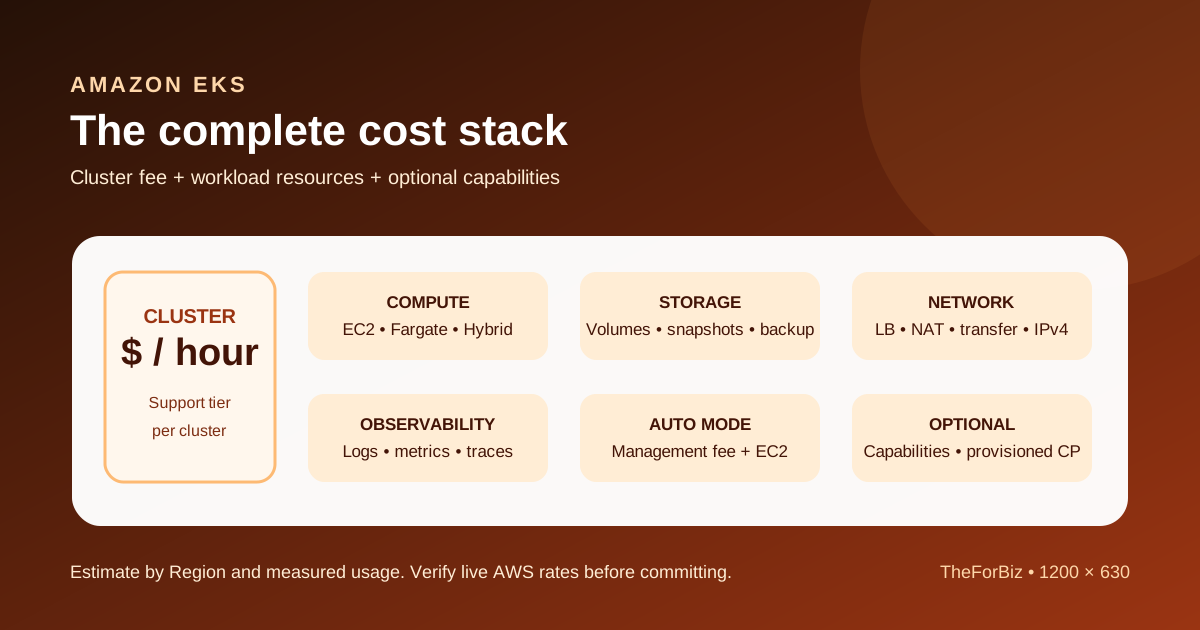
Amazon EKS cost is the cluster fee plus the AWS resources and optional EKS features used by the workload. As of October 25, 2026, AWS lists $0.10 per cluster-hour while a Kubernetes version is in standard support and $0.60 per cluster-hour in extended support. There are no minimum fees or upfront EKS commitments.
At 730 hours, the base cluster fee is about $73 per month in standard support or $438 in extended support before compute, storage, networking, observability, support, taxes, or optional features. Use the live AWS pricing page and AWS Pricing Calculator for a decision because rates, regions, instance prices, and service terms can change.
Continue reading: Read the concise EKS definition · Understand the EKS platform · AWS: Amazon EKS pricing ↗
The EKS cluster fee
The hourly cluster fee pays for the managed Kubernetes control plane and is charged for each running cluster. Standard support lasts for the first 14 months after an EKS Kubernetes version is released. Extended support then provides up to 12 additional months at the higher rate documented by AWS.
Cluster sprawl therefore creates a visible fixed cost even when workloads are idle. Separate clusters can be justified by isolation, ownership, blast-radius, regulatory, or lifecycle requirements, but environment boundaries should be intentional rather than automatic.
| Support tier | Hourly cluster fee | Approximate 730-hour month |
|---|---|---|
| Standard support | $0.10 | $73 |
| Extended support | $0.60 | $438 |
Compute charges
Most EKS spend comes from the capacity that runs Pods. The billing model depends on whether workloads use EC2 nodes, EKS Auto Mode, AWS Fargate, Hybrid Nodes, or another supported model. The cluster fee remains separate.
EC2 managed and self-managed nodes
For EC2 worker nodes, you pay the normal EC2 price for instance capacity and any attached resources. Savings Plans, Reserved Instances, Spot capacity, Graviton, right-sizing, scheduling, and autoscaling can change the result. Managed node groups do not add a separate EKS node-group fee, but the underlying resources are billable.
EKS Auto Mode
Auto Mode charges a management fee that varies by instance type and duration, in addition to the EC2 price and the EKS cluster fee. Compare that fee with the engineering work and third-party components it may replace. Review the current supported instance and pricing tables before choosing it.
AWS Fargate and Hybrid Nodes
Fargate bills the vCPU, memory, operating-system, and storage dimensions documented on the AWS Fargate pricing page for eligible Pods. EKS Hybrid Nodes use tiered per-vCPU-hour pricing for connected on-premises or edge capacity, plus the EKS cluster fee and relevant connectivity costs.
Continue reading: How EKS Auto Mode works · AWS: Fargate pricing ↗
Storage, networking, and data transfer
Persistent volumes can create EBS, EFS, FSx, S3-related, snapshot, backup, and provisioned-performance charges depending on the storage design. Deleting a Pod or cluster does not necessarily delete every volume, snapshot, or backup, so retention rules need cost ownership.
Networking can include load balancers, NAT gateways, public IPv4 addresses, inter-Availability Zone traffic, internet data transfer, PrivateLink endpoints, and traffic inspection. AWS also documents customer-side data-transfer charges for communication between EKS control planes and worker nodes through requester-managed network interfaces.
Continue reading: AWS: EKS VPC and subnet requirements ↗
Observability, security, and optional capabilities
CloudWatch logs, metrics, dashboards, traces, GuardDuty features, image scanning, backup, KMS requests, and third-party platforms can be material at scale. Logging everything without retention and filtering can be expensive; logging too little can make incidents and outages harder to investigate.
EKS Capabilities and Provisioned Control Plane have their own pricing where used. Provisioned Control Plane pricing is added to the normal cluster support-tier fee. Review the current AWS table for the selected capacity tier rather than copying a static rate into architecture documents.
How to estimate an EKS monthly bill
Build the estimate from usage units, not a single per-cluster number. Use the actual Region, support tier, compute profile, storage, traffic pattern, logging volume, availability design, and optional managed features. Then compare the estimate with measured usage after deployment.
- Multiply running clusters by hours and the applicable support-tier rate.
- Estimate baseline, peak, and Spot or On-Demand compute by instance type or Fargate dimensions.
- Add Auto Mode, Hybrid Nodes, Capabilities, or Provisioned Control Plane charges where applicable.
- Add volumes, snapshots, backup, load balancers, NAT, public IPv4, endpoints, and data transfer.
- Estimate logs, metrics, traces, image scanning, security monitoring, and support.
- Model development and test shutdown schedules, idle capacity, failed jobs, and retained resources.
- Validate with Cost Explorer, cost-allocation tags, Kubernetes cost data, budgets, and anomaly detection.
Ways to control EKS cost without weakening reliability
Start with workload requests and limits because scheduling and autoscaling depend on them. Right-size node families, mix purchase options according to interruption tolerance, remove abandoned resources, and keep Kubernetes versions in standard support unless a planned exception justifies extended support.
Consolidation can reduce fixed cluster fees but may increase blast radius and governance complexity. High availability can increase steady-state resource use but reduce outage risk. Cost optimization is therefore an engineering decision that balances price, reliability, security, and team effort.
Continue reading: Compare ECS and EKS operating models
Frequently asked questions
Is Amazon EKS free?
No. Each EKS cluster has an hourly support-tier fee, and you also pay for compute, storage, networking, observability, and other resources used by workloads.
How much is the EKS control plane?
As of October 25, 2026, AWS lists $0.10 per cluster-hour during standard Kubernetes version support and $0.60 during extended support.
Does EKS Auto Mode include EC2 cost?
No. Auto Mode adds a management fee based on managed EC2 instance usage. The normal EC2 and EKS cluster charges still apply.
Do managed node groups cost extra?
AWS does not list a separate managed-node-group fee. You pay for the underlying EC2 instances and related resources, along with the EKS cluster and any other service charges.
Why can an idle EKS cluster still cost money?
The hourly cluster fee continues while the cluster runs, and baseline nodes, load balancers, NAT gateways, storage, public IPv4 addresses, logs, or other retained resources may also remain billable.